

 |
|
The plate heat exchanger began its triumphal progress in refrigeration systems
approximately 20 years ago, and is an indispensable feature today due to its compact
construction and thermal performance.
Resistance to the media entering the equipment (refrigerants, compressor oils,
coolant) is prerequisite for the employment of plate heat exchanger in refrigeration
systems.
In closed secondary circuits, the most varied refrigerant oils are employed.
These are selected dependent on the required operating range, since their physical
properties, such as density, viscosity, thermal conductivity and heat capacity,
vary widely with temperature.
According to energy demand, the coolant oil flows through one or more heat exchangers
arranged in parallel. In complex cooling systems, part-flows are diverted from
a central circuit according to requirement and, according to work profile, routed
to the "refrigeration consumption location" through a local plate heat
exchanger. |
Typical areas of application of plate heat
exchangers in refrigeration cycles are:
- Vaporization of refrigerants
- Condensation of refrigerants
- Employment as economizer
- Cooling of compressor oil
- De-coupling of refrigeration from central refrigeration cycles
- Cooling of cooling circuits
Application example: For NH3 systems
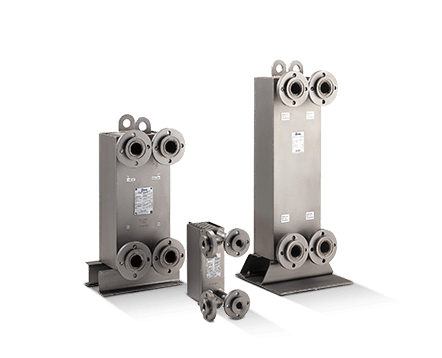
If ammonia is employed as a refrigerant, compact, welded plate heat exchangers
can be employed since rubber sealing cannot guarantee 100% leak-tightness
of the ammonia circuit. These welded plate heat exchangers are available for
small to medium volume flows as fully welded equipment (solid stainless steel
pressure frame) under the type designations SIGMAWIG ST 3,
ST 12 and ST 18. For example, equipment of the type SIGMAWIG ST
3 is employed in different sizes in tempering devices for test stands
in the computer and semi-conductor industry. A significant requirement
in this case is a chemically pure and copper-ion-free circulation process,
in order to avoid contamination of the component parts, printed circuit
boards and printed circuit boards.
The equipment units with the designations SIGMAWIG ST
30 and SIGMAWIG ST 40 are suitable for large energy transfer
capacities and volume flows, with welded plate package in painted pressure frames. |
|